
Table of Contents
Why district leaders need a framework for evaluating youth AI safety
During Mental Health Awareness Month, Common Sense Media and Stanford Medicine’s Brainstorm Lab released one of the most comprehensive independent evaluations to date of AI mental health and wellbeing tools used by teens.
The findings delivered a clear message for K12 leaders: students are already turning to AI for emotional support, but not all AI tools are designed to support young people safely.
For school districts, this is no longer a future-facing conversation. It is an immediate issue tied to student safety, governance, and responsible support systems.
At the same time, the report highlighted something equally important: safer, school-based AI models are possible.
Alongside by TimelyCare was recognized by Common Sense Media as one of the lowest-risk AI wellbeing tools reviewed. The evaluation emphasized the importance of human oversight, clear safety protocols, district integration, and clinically governed design.
This distinction matters because district leaders are increasingly being asked to evaluate student-facing AI tools without a clear framework for differentiating between:
- General-purpose AI
- AI companion apps
- Purpose-built student support tools
Those categories carry very different levels of risk.
“One of the clearest takeaways from the Common Sense report is that not all AI mental health tools should be viewed the same way. The greatest risks appear when AI is used as a substitute for care. Alongside was built with a different purpose: to provide Tier 1 skill-building support that helps students navigate everyday challenges, with clear pathways to trusted adults and school staff when something more serious arises.”
Dr. Elsa Friis, Ph.D., Msc-GH
Director of Product and Clinical Care
Alongside, by TimelyCare
Key Takeaways
- Students are already using AI for emotional support and wellbeing questions.
- The Common Sense Media report found meaningful safety differences between AI tool categories.
- Design intent, human oversight, and escalation pathways are critical factors in youth AI safety.
- District leaders need structured evaluation frameworks for student-facing AI.
- The S.U.R.E. Framework helps schools assess AI tools across safety, understandability, restrictions, and ethics.
- AI should support human connection and student support systems, not replace them.
What realities are schools navigating today?
Students are growing up in an environment that is constantly connected, emotionally demanding, and increasingly difficult to navigate alone. Many students are digitally fluent, yet still struggle with stress, isolation, belonging, and academic pressure.
At the same time, students are already using AI tools to ask questions they may not feel comfortable bringing to adults.
Research highlighted by Common Sense Media found:
- More than 70% of teens have used AI chatbots
- Nearly 1 in 3 teens and young adults have turned to AI for emotional or mental health support
- Millions of youth are already using general AI tools for emotional advice
The question for districts is no longer whether students are using AI. The more urgent question is whether the AI tools they are using are designed to protect them.
What did the Common Sense Media report find?
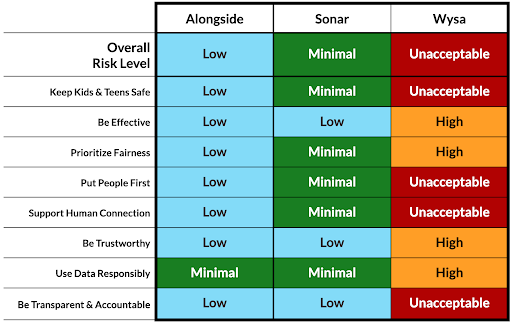 One of the clearest conclusions from the report was that design intent matters.
Tools built primarily for engagement or open-ended emotional conversation carried significantly higher risks for youth emotional safety. By contrast, school-based support models with human oversight, defined safety protocols, and structured escalation pathways demonstrated meaningfully lower risk.
The findings reinforced an important distinction for schools: this is not simply a conversation about AI versus non-AI. It is a conversation about governance, accountability, and whether AI is designed to strengthen human connection rather than replace it.
“In our view, safety comes from thoughtful safeguards, strong oversight, and clear limits around what AI should and should not do. AI should not replace counselors, clinicians, or the human relationships that are at the center of care. TimelyCare and Alongside are aligned around that principle: coaching for everyday needs, clear clinical boundaries, and connection to human support when it matters most.”
Dr. Elsa Friis, Ph.D., Msc-GH
Director of Product and Clinical Care
Alongside, by TimelyCare
The AI landscape: three categories, three different risk profiles
Not all AI systems are built for the same purpose, and those differences directly affect student safety outcomes.
General-purpose AI tools are designed for broad, open-ended interaction. While widely accessible, they are not typically built with youth mental health safeguards, escalation protocols, or district accountability structures in mind.
AI companion apps are often designed to maximize engagement and emotional attachment. These systems may encourage dependency or simulate human relationships in ways that create additional risks for young users.
Purpose-built student support tools are designed specifically for school environments, with structured boundaries, safety protocols, human escalation pathways, and district oversight integrated into the experience.
For district leaders, evaluating AI through the lens of design intent can help clarify which tools align with student wellbeing goals and which may introduce avoidable risk.
Not all AI is built the same. It’s the design intent that determines safety outcomes.
Category 1
Companion AI
Apps
Character.AI · Replika · Nomi
Not designed for emotional support, but widely used for it. No logic model for youth. Vast risk surface with no age-appropriate safeguards.
Category 2
Commercial/Consumer AI (Gen AI Apps)
ChatGPT · Gemini · Meta AI
Designed to maximize engagement and fundamentally misaligned with youth safety.
Rated unacceptable risk by Common Sense Media & Stanford.
Category 3
Purpose-Built AI for Student support
Alongside & Educationally Designed Tools
Expert oversight + human integration + logic model = meaningful benefit.
Research backed under ESSA or third party validations.
What does this mean for district leaders evaluating AI?
AI is already present in schools through student use, classroom tools, tutoring platforms, and wellness applications. The challenge is no longer whether districts will encounter AI, but how they will evaluate and govern it responsibly.
The Reality Check: AI Is Already in Your Schools
This isn’t a future problem; it’s happening in your hallways right now.
70%+
of teens have used an AI chatbot at least once
3 in 4
teens have used an AI companion
52%
of teens are regular companion users
~5.4M
U.S. youth use gen AI for emotional advice
The question isn’t whether your students are using AI. It’s whether the AI they’re using is designed to protect them.
Does the AI protect the user from harm? And I wanna be really clear here. Safety for us is not score is not scored on a scale. It's a binary. It's pass or fail. If our chatbot, makes an error with, safety, it totally fails from our perspective, and the evaluation stops. There's no score. There's no, well, we got a b plus on everything else. If it's not safe, it doesn't move forward.
As districts consider AI-enabled student support tools, the conversation should focus on governance, accountability, transparency, and safety by design, not simply engagement metrics or scalability.
Districts need a practical framework for evaluating these tools consistently. That is why Alongside developed the S.U.R.E. Framework.
Introducing the S.U.R.E. Framework
A framework designed specifically for youth AI safety
The S.U.R.E. Framework is a 40-item evaluation framework developed to assess AI-enabled chatbot interactions with youth ages 9+.
The framework evaluates four critical dimensions:
- Safety: Crisis response protocols, escalation pathways, and student protection measures
- Understandability: Developmentally appropriate language and youth-centered communication
- Restrictions: Boundaries that prevent harmful dependency or inappropriate interactions
- Ethics: Transparency, accountability, and responsible AI governance
One of the most important aspects of the framework is that safety is not graded on a curve.
The “Safe” category functions as a binary gate. If a tool fails the safety evaluation, the assessment stops.
This gives districts a more concrete way to evaluate AI products beyond broad marketing claims or general promises about innovation.
S
Safety
Safety identification, alerts and data privacy
U
Understandable
Developmentally appropriate and accessible content
R
Restricted
Guardrails limit both content and engagement
E
Ethical
Credible content, non-sycophantic, supports human connection
Questions every district should ask AI vendors
District leaders do not need to become AI engineers to evaluate student-facing AI responsibly. They do, however, need a clear framework for asking the right questions.
Safety
- Does the product have a documented crisis response protocol?
- How are severe issues escalated to human support?
- Who is notified if a student signals distress?
- Does the tool actively encourage connection to trusted adults?
Understandability
- What age range was the product designed for?
- Has it been tested specifically with youth?
- Is the reading level developmentally appropriate?
Restrictions
- What prevents unhealthy emotional dependency?
- Does the tool reinforce real-world support seeking?
- How does the system handle boundary-testing behavior?
Ethics
- Is the tool transparent about what it is?
- Does it avoid presenting itself as a therapist or human companion?
- Is decision-making auditable and documented?
- If vendors cannot answer these questions clearly, that is important information for districts to consider.
Why does this matter for MTSS and student support systems?
Districts are increasingly being asked to support every student with systems originally designed for only a fraction of student needs.
At the same time, many student challenges begin long before they become visible through disciplinary issues, academic decline, or crisis intervention. Students experiencing stress, disconnection, or emotional overwhelm often need earlier and lower-barrier forms of support.
That is where structured Tier 1 support can play an important role.
Alongside by TimelyCare was designed as a private, judgment-free first step where students can work through everyday stress, peer conflict, motivation challenges, and emotional overwhelm before issues escalate.
Importantly:
- It is not therapy
- It is not a replacement for counselors
- It is not an AI companion product
Instead, it is designed to extend district capacity while reinforcing human support systems. When higher-acuity concerns surface, structured escalation pathways connect students to trusted adults and appropriate support resources.
Additional resources for districts evaluating AI
District leaders looking to build stronger governance and evaluation processes around AI-enabled student support tools can explore the following resources:
Building Safer AI Support Systems for Students
Students are already using AI in their daily lives, including for emotional support and wellbeing questions. The responsibility for districts is not simply deciding whether AI belongs in schools. It is determining which systems are designed to support students safely, responsibly, and transparently.
As AI adoption accelerates, governance and safety-by-design principles will become increasingly important for protecting student wellbeing and maintaining trust within school communities.
Contact us to learn how we can help your schools thrive.
FAQs
Yes. Research cited by Common Sense Media found that many teens and young adults are already turning to AI chatbots for emotional support and wellbeing-related questions. This makes responsible AI governance an urgent issue for schools.
Some AI tools are designed for engagement and open-ended emotional interaction rather than structured student support. Without safeguards, human oversight, or escalation protocols, these systems may create greater risks for emotional dependency or inappropriate guidance.
Districts should evaluate safety protocols, escalation pathways, developmental appropriateness, transparency, and ethical safeguards. Clear governance and accountability structures are essential.
The S.U.R.E. Framework is a 40-item evaluation framework designed to assess AI-enabled chatbot interactions for youth ages 9 and older. It evaluates safety, understandability, restrictions, and ethics.
No. Alongside is designed to complement existing student support systems, not replace counselors or clinicians. The platform is intended to help students navigate everyday challenges while reinforcing pathways to trusted adults and professional support when needed.