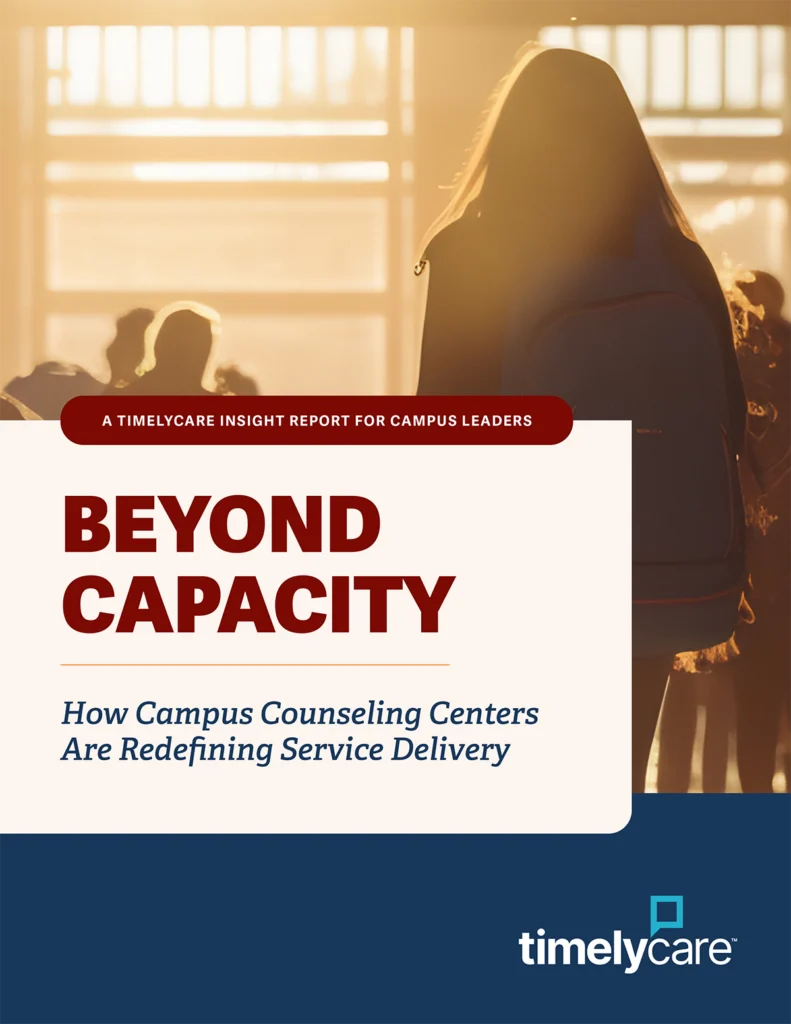
Counseling leaders are clear. Student mental health needs are rising. Staffing and budgets are not keeping pace. The traditional 9-to-5 model cannot carry the full weight of demand.
This report shares what CAPS leaders told us and outlines the new service delivery playbook.
Get the report by completing the form.
A TimelyCare Insight Report for Campus Leaders
Counseling centers are managing a new baseline. It is higher, more complex, and more persistent.
Leaders described a landscape where access can feel stable on paper, yet fragile in practice. One clinician out sick, a campus incident, or a spike in crises can quickly strain the system. Nights, weekends, and breaks remain pressure points. Equity gaps persist. Burnout and attrition are real.
Virtual care is no longer a nice-to-have. Leaders increasingly view it as essential infrastructure, and they want partners who can demonstrate impact, not just add appointments.
- Demand is rising faster than capacity.
- Staff are deeply committed, but stretched thin. Burnout and attrition are shaping what centers can sustain.
- After-hours access is inconsistent. Students need clear options for nights, weekends, and breaks.
- Clinical outcomes are the new standard. Utilization alone is not enough for cabinet and board conversations.
- Equity is a priority with unresolved gaps. Provider diversity and culturally responsive options remain major challenges.
- Quality and integration determine trust. Leaders want continuity, clear handoffs, and transparent data.
Campus Leaders Need Visibility Into Whether Support Is Working
Campus leaders are increasingly asked to answer a simple question with high stakes: Is support improving students’ well-being and helping them stay enrolled?
The report explores what counseling leaders want visibility into, including symptom change, engagement, acuity trends, and student-reported experience. It also explains why measurement-based care is becoming central to evaluating partners.
Counseling Centers Are Beyond Capacity, but Students Still Need Help
Demand continues to climb, while ratios and staffing constraints limit what centers can provide. This report unpacks what leaders shared about caseload pressures, wait times, and after-hours coverage, and why hybrid models are becoming a stabilizing strategy.
Support Resources Are Limited
Budget constraints force hard decisions. Leaders are looking for clearer ways to connect mental health investment to retention, persistence, and efficient use of clinician time. The report outlines the ROI themes leaders raised and what data they want to bring into cabinet-level conversations.
Who Is Actually Getting Help
Access is only access when students feel able to use it. Leaders described progress and persistent gaps related to provider diversity, cultural responsiveness, language options, trust, and stigma. The report highlights what is working and what remains difficult.
Students Deserve Compassionate, Personalized Care
Quality is what turns access into meaningful support. Leaders shared what increases confidence in virtual care, what lowers it, and what is required for a consistent student experience. The report also links service quality to clinician wellbeing and sustainability.
Across the survey, a consistent model is emerging. Counseling centers are redesigning service delivery around five priorities:
Clinical Outcomes
Use validated tools and shared data to track progress and communicate impact.
Access
Build hybrid ecosystems that meet students on campus, online, after hours, and across time zones.
Return on Investment
Extend capacity per dollar and strengthen the case for sustainable resourcing.
Equity
Design care that reaches diverse student populations with culturally responsive options.
Service Quality
Protect consistency, coordination, and staff wellbeing, so support remains effective and sustainable.
- CAPS directors and senior counseling leaders
- VPSAs, VPs for Student Success, and deans
- Student health and well-being leaders
- Cabinet leaders responsible for resourcing and outcomes
How TimelyCare Partners with Campuses
TimelyCare is designed to be a capacity multiplier and an equity amplifier for campus counseling centers, not a replacement.

Clinical outcomes: Measurement-based care and reporting that supports campus and cabinet conversations

Access: 24/7 options and scheduled care across time zones and modalities

ROI: Scalable support that expands capacity without a direct one-to-one staffing increase

Equity: Diverse provider networks and identity-affirming options, including language considerations

Service quality: Rigorous clinical standards, supervision, escalation pathways, and continuous improvement
FAQs
An insight report based on a national survey of CAPS leaders, focused on how counseling centers are adapting service delivery in response to rising demand and constrained resources.
Clinical outcomes and measurement, access and after-hours coverage, ROI, equity and provider diversity, service quality, and the emerging hybrid care playbook.
Leaders shared that utilization counts alone no longer answer the questions senior decision makers are asking. Outcomes data is increasingly required to demonstrate impact and guide investment.
The report provides benchmarks, leader perspectives, and a practical framework for evaluating care models and partners with a focus on sustainability, equity, and measurable results.
Methodology
TimelyCare conducted an online survey of college and university counseling and psychological services leaders across the United States. Respondents were primarily directors and senior leaders. The fielding period was November 24, 2025, through December 18, 2025.